
Homemade Ice Cream in Freezer Bags
Making ice cream in freezer bags gives children a hands-on way to see how ingredients change with cold, salt, and motion. It feels like a treat, but it also works well as a simple science activity with measuring, mixing, and observation built in.
How To Run It
- Put the milk, sugar, and vanilla into a small sealed bag and check that it is closed tightly.
- Fill a larger freezer bag with ice and rock salt, then place the smaller bag inside it and seal the larger bag.
- Have the children shake, roll, or gently toss the bag for several minutes until the mixture thickens into ice cream.
- Wipe off the small bag before opening it so salt water does not get into the ice cream.
- Scoop the ice cream into cups and let the children taste it while talking about what changed during the process.
Helpful Tips
- Use towels or gloves because the bags get very cold.
- Double-bag the ice cream mixture if you are worried about leaks.
- Pre-measure ingredients if you want the activity to move faster.
- Milk will work, but half-and-half usually makes a creamier ice cream that freezes more reliably.
- A non-dairy version can work too, especially with canned coconut milk or a richer oat-based creamer.
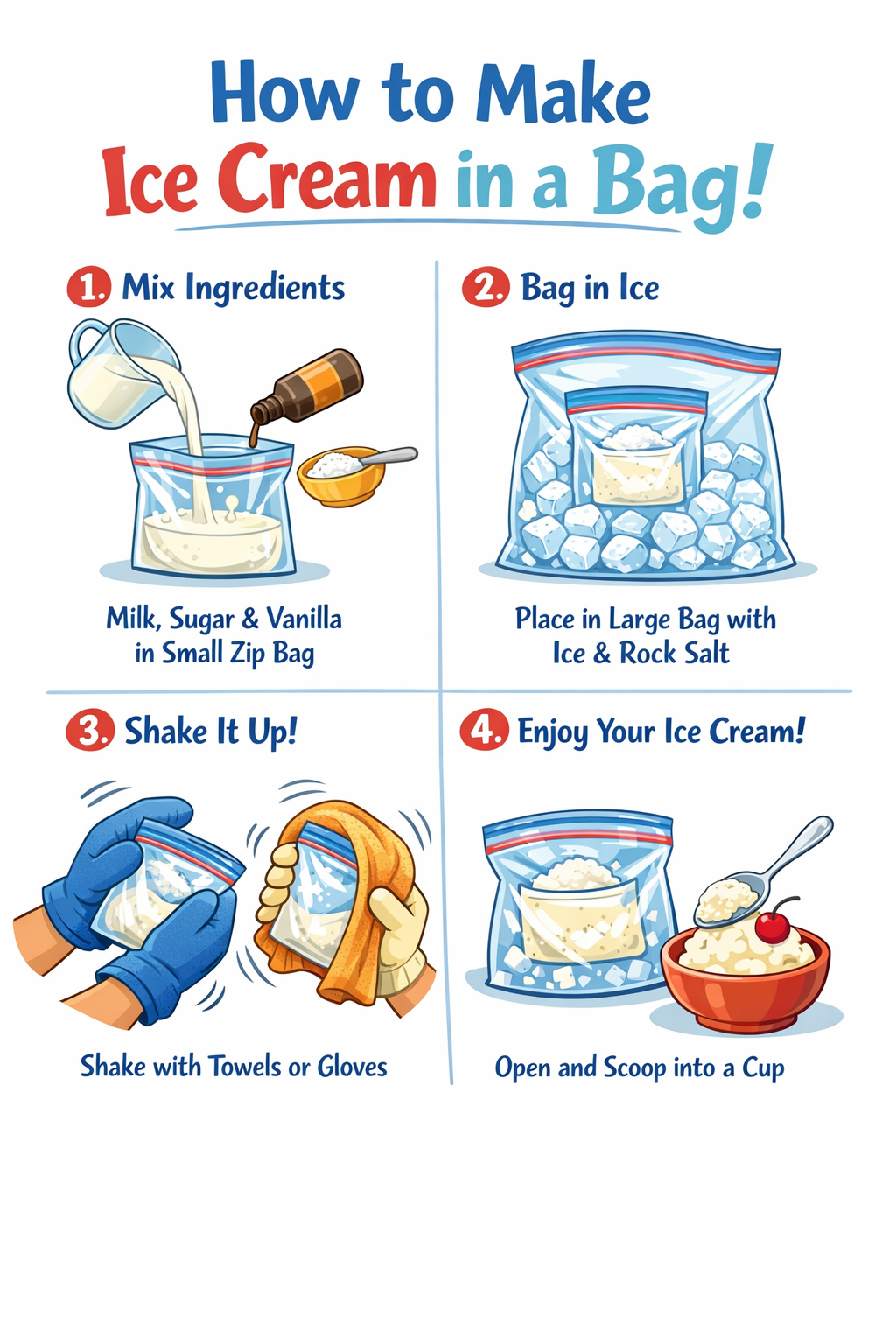
Step Illustration
This visual shows the basic freezer-bag method from mixing ingredients to shaking and serving.
Printable Recipe Cards
Print these recipe cards for leaders or helpers. They are simple enough to keep at each table while the children make the ice cream.
Classic Vanilla
Small bag: 1/2 cup half-and-half or whole milk, 1 tablespoon sugar, 1/4 teaspoon vanilla.
Large bag: 3 cups ice and 3 tablespoons rock salt.
Directions: Seal the small bag, place it inside the large bag, and shake 5 to 8 minutes until thick.
Chocolate
Small bag: 1/2 cup half-and-half or whole milk, 1 tablespoon sugar, 1 teaspoon chocolate syrup or 1 teaspoon cocoa mixed well.
Large bag: 3 cups ice and 3 tablespoons rock salt.
Directions: Seal the small bag, place it inside the large bag, and shake 5 to 8 minutes until thick.
Strawberry
Small bag: 1/2 cup half-and-half or whole milk, 1 tablespoon sugar, 1 tablespoon strawberry jam or syrup.
Large bag: 3 cups ice and 3 tablespoons rock salt.
Directions: Seal the small bag, place it inside the large bag, and shake 5 to 8 minutes until thick.
Non-Dairy Vanilla
Small bag: 1/2 cup canned coconut milk or rich oat-based creamer, 1 tablespoon sugar, 1/4 teaspoon vanilla.
Large bag: 3 cups ice and 3 tablespoons rock salt.
Directions: Seal the small bag, place it inside the large bag, and shake 5 to 8 minutes until thick. It may stay a little softer than the dairy versions.